100%
Adoption rate
85%
Reduction in licensing costs
20%
Increase in platform subscription revenue
Role
Lead Product Design
Team
2 designers, 1 PM, 8 developers
Timeline
4 months
01
Context
This project is to build a native email marketing tool into an e-commerce product suite. The product suite gives businesses a single place to run their online store, with tools spanning sales, operations, and marketing. Due to prior limitations, email marketing features were offered through a third-party tool with its own interface.
02
Problem
Unlike other native tools in the product suite, email marketing ran through AutomateWoo, a third-party tool with its own interface. Users had to leave the product suite and log in to a different product to use email marketing features. On top of that, AutomateWoo's rigid features often couldn't support the campaigns users wanted to build, forcing workarounds.
This dependency also worked against the business as licensing fees grew with every new customer, and any downtime or bugs couldn't be resolved right away.
What users say
/3/
I signed up for one platform, but I had to learn a completely different interface.
Marketing Manager
Runs day-to-day email campaigns
What stakeholders say
/3/
Every new customer we signed meant a bigger bill from AutomateWoo. Our growth was directly increasing our costs.
Head of Product
Oversees product strategy and roadmap
03
Solution
Below are the key design decisions that shaped this project's outcomes. For each one, I first focused on solving the underlying challenge, then weighed it against constraints.
Preserve familiar structure
Challenge
All existing users needed to transition to the native solution without disrupting their day-to-day workflow or experience.
Constraint
Users relied on AutomateWoo's existing structure to navigate and get their work done. Restructuring it risked disorienting them at the exact moment they needed things to feel familiar.
Design Decision
I prioritized preserving that familiarity over building something new. Getting users through a smooth transition came first, before improving the experience further.
The result is a smooth transition to the native solution

Expand core functionalities
Challenge
Beyond replacing AutomateWoo, the native solution needed to have attractive offerings so users would want to stay after transitioning.
Constraint
Users raised a long list of features that could make the native solution more attractive. But the timeline didn't allow building all of them at once.
Design Decision
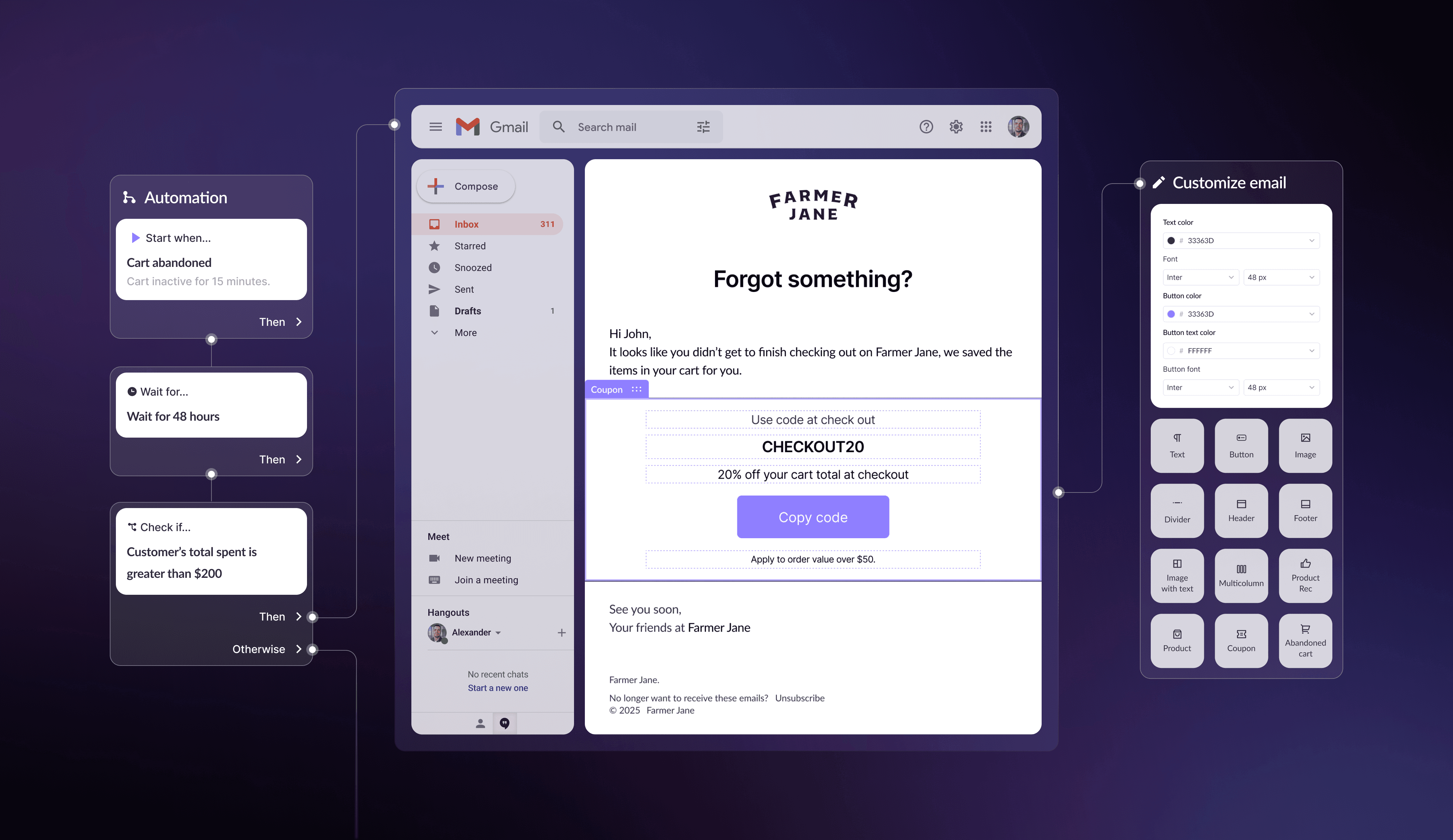
Instead of building new features, I focused on strengthening what was already there. Email templates and workflow automation were the two areas with the biggest impact on day-to-day efficiency, so they became the priority.
Users get the features they need most


Structured to sell separately
Challenge
Email marketing had always been bundled with another product's fixed pricing. The new tool was more capable, and it needed a way to be charged for separately.
Constraint
Under the current product structure, the email marketing tool is nested inside another product. There was no way to attach a separate charge to a fixed-price product due to technical constraints.
Design Decision
I positioned email marketing as a new addition to the product suite, at the same level as other native tools, rather than nested inside one. This allows it to be charged for individually, while also giving it its own place in the main navigation, attracting new users.
This created a new revenue stream

04
Impact
100%
Adoption rate
Users transitioned fully off the third-party tool.
85%
Reduction in licensing costs
Removing the third-party fees cut costs directly.
20%
Increase in platform subscription revenue
Positioning the native tool as its own product grew the platform's total subscription revenue.
05
Process
Co-creation approach to building a new solution
This was a completely new build, not a redesign of something that already existed. With no existing ground to build on, I needed as much input as possible from the right people at each stage. My process involved working with stakeholders, users, and engineering.


06
Next Step
A handful of advanced campaign features came up during user research but didn't make the first release. The next step is building those out, along with expanding current capabilities based on how users are using the tool now that it's live.