
35%
Increase in SEO customization usage
80%
At-risk clients retained
7/10
Users report SEO ranking improvement
Role
Product Design
Team
1 designers, 1 PM, 5 developers
Timeline
3 months
01
Context
This project set out to improve the SEO customization feature of a SaaS e-commerce operations platform. The platform gives store owners a single place to manage their online stores, from products to orders to customer relationships. SEO customization has long been one of its stronger selling points, helping online stores shape how their products show up in search.
02
Problem
The SEO customization feature was designed for SEO specialists, and it assumes a level of expertise that most store staff don't have. The current interface left non-expert users unsure how to work on SEO. And most stores couldn't afford to hire specialists.
On top of that, competitors were offering simpler SEO tools, which gave the business a real reason to worry about losing clients.
What users say
/3/
I knew SEO mattered, but I had no idea what my score even meant, let alone how to improve it.
Store Owner
Runs a small e-commerce shop
What stakeholders say
/3/
We were losing deals to competitors who made SEO simple. It was becoming a real reason people chose someone else.
Sales Manager
Sells the product to new clients
03
Solution
Below are the key design decisions that shaped this project's outcomes. For each one, I first focused on solving the underlying challenge, then weighed it against constraints.
Simplify SEO with AI assistance
Challenge
SEO scores meant little to users who weren't SEO experts. Raw scores and technical breakdowns left them stuck, unsure what any of it meant or where to start.
Constraint
AI-generated information isn't always accurate. And letting users rely on it completely to make SEO decisions was risky.
Design Decision
I turned the raw SEO score into a short list of actions, guiding users on what to do next instead of leaving them with a number they didn't understand. Alongside it, an AI-powered search let users ask "why" and get an answer based on their store's own context, turning the feature into something that taught SEO, not just scored it. To limit the risk of AI inaccuracy, I kept it in an assistant role rather than a decision-maker.
SEO became simple for non-experts to handle

Guide users with field-level AI
Challenge
Knowing which actions to take didn't mean knowing how to execute them. Users might know their product description needed work but still have no idea what to write.
Constraint
The feature wasn't monetized, so AI token usage had to stay minimal. Long, open-ended conversations weren't sustainable within that budget.
Design Decision
Since usage had to remain minimal, I attached a focused AI assistant to individual editable fields rather than an open conversation. Users make a single request, and the AI acts on it directly, providing targeted help without the cost of back-and-forth dialogue.
Users got targeted AI help where needed

04
Impact
35%
Increase in SEO customization usage
Users adopted the AI assistant quickly, engaging with SEO customization far more than before.
80%
At-risk clients retained
Sales used the new feature to win back clients who were ready to cancel over poor SEO performance.
7/10
Users report SEO ranking improvement
Users who adopted the AI assistant said their products moved up in search, landing on the first page of Google.
05
Process
User-centric approach to improve an existing feature
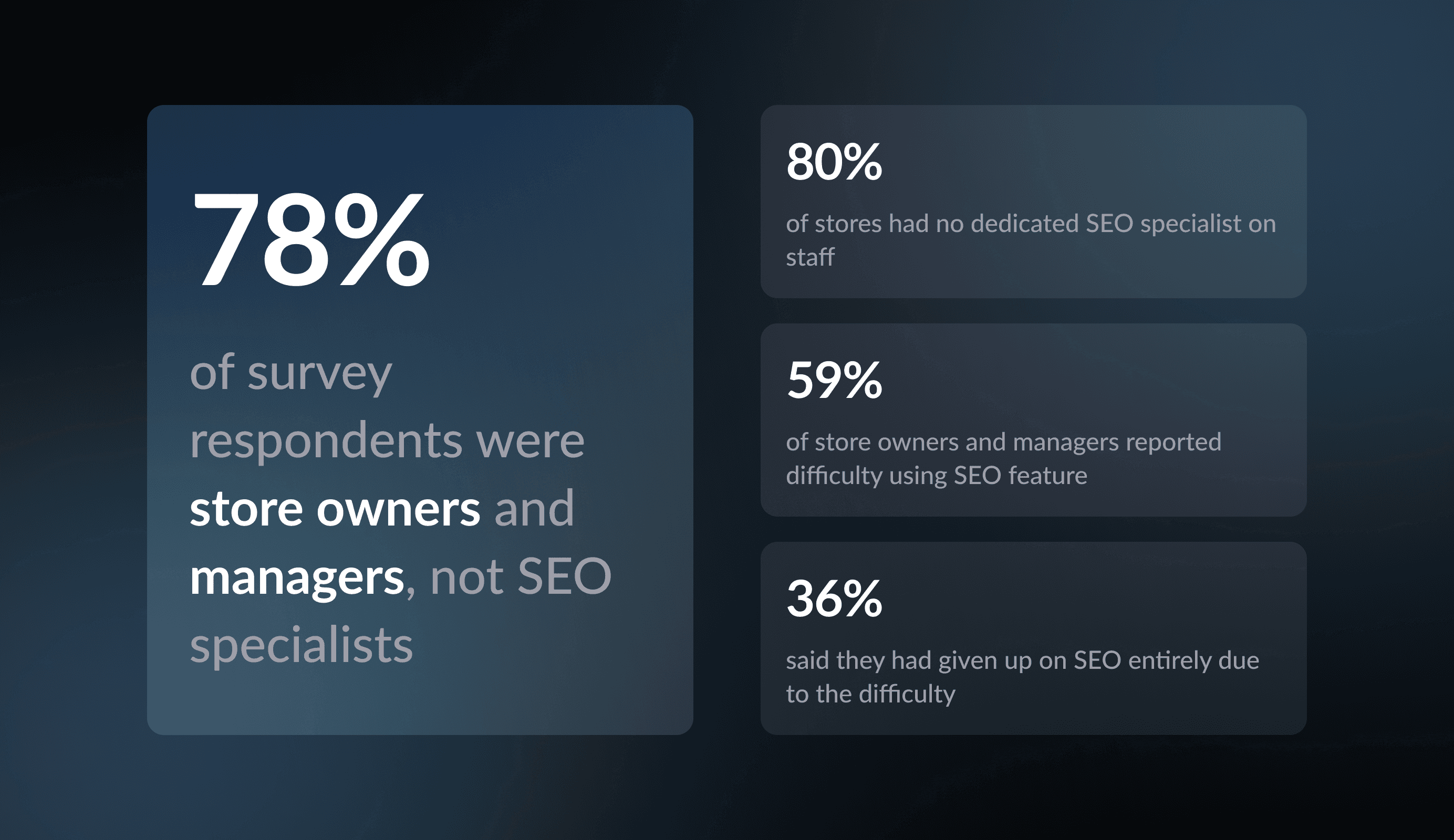
The problem started with the user experience, not the technology, so I kept users at the center of every stage. My process moved from discovering who was actually using the feature, to understanding how they used it, to co-designing the solution with them, to gathering their feedback on prototypes before anything was built.


06
Next Step
Right now, users still review and act on SEO suggestions one product at a time, which gets harder as a catalog grows. I want to explore letting the AI handle that at scale, scanning a store's full catalog and flagging what needs attention, with users staying in control of what actually gets changed. It's still early, but it feels like the natural next step for stores with larger catalogs.